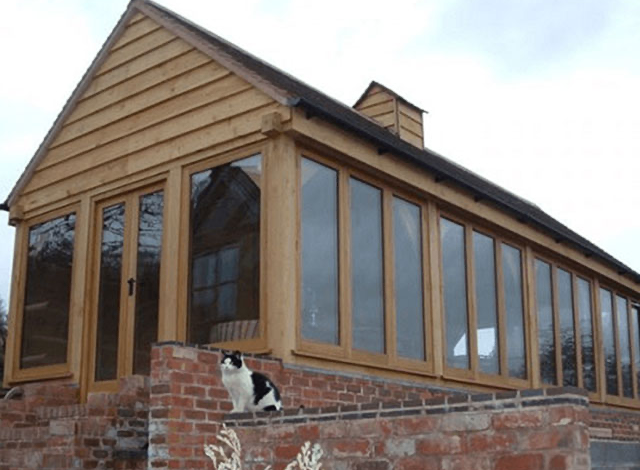
There is a big difference between putting together an oak-framed building and actually building one.
Mass-produced timber kits have their place. They’re designed to be manufactured quickly, transported efficiently and assembled from a set of standard components. That can make them practical for certain projects, but it also means working within someone else’s measurements, designs and production methods.
Hand-crafted oak is a different proposition altogether.
For a substantial country property, a bespoke extension, annexe or garden building isn’t simply another construction project. It’s something that should feel like it belongs to the property for decades to come. That’s where traditional oak framing comes into its own.
At WM Oak Frame, the emphasis is on craftsmanship, natural materials and traditional construction methods – the sort of details that are easy to overlook until you see them up close.
It Starts With the Joint
Walk into a traditionally constructed oak frame and one of the first things you’ll notice is the joinery.
A traditional mortise and tenon joint connects two pieces of timber by cutting a projecting section, the tenon, into one piece and a corresponding opening, the mortise, into the other. Once fitted together, the joint creates a strong structural connection without relying solely on modern metal fixings.
It is an old technique, but there’s a reason it has survived.
Good oak framing isn’t about hiding how the building has been made. The joints are part of the architecture. They can be seen in the finished frame, giving the structure a sense of depth and character that you simply don’t get from a collection of standardised timber sections.
And because each joint is made for the particular pieces of oak being used, the frame can be genuinely bespoke.
Wooden Pegs With a Purpose
Then there are the wooden pegs.
Rather than treating timber as a collection of identical components, traditional framing brings individual pieces together using carefully crafted joints and hardwood pegs. The peg passes through the joint, locking the timbers together and becoming another visible reminder of the craftsmanship involved.
There’s something wonderfully tactile about this.
You can see where the frame has been assembled. You can see the joints, the pegs and the subtle variations in the timber. These aren’t decorative details added afterwards to make a modern building look traditional. They’re part of the way the structure is made.
That distinction matters when you’re investing in a building where the craftsmanship is supposed to be one of its defining features.
No Two Pieces of Oak Are Quite the Same
One of the pleasures of working with oak is that it isn’t perfectly uniform.
Every piece has its own grain, knots, colour variations and natural characteristics. A craftsman needs to understand those differences rather than simply treating every length of timber as interchangeable.
This is particularly important when creating a bespoke frame.
Instead of designing around a predetermined kit of standard components, the frame can be considered as a whole. The proportions, openings, roof structure and individual joints can all be developed around the building and the site.
That’s a very different mindset from mass production.
Craftsmanship You Can Actually See
There’s a tendency to think of craftsmanship as something hidden behind walls. With oak framing, much of it is right there in front of you.
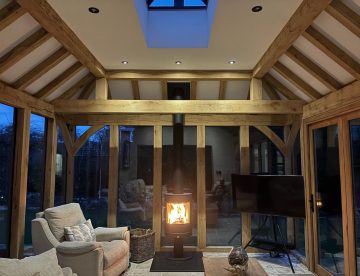
The beams become part of the finished interior. Curved timbers can follow natural forms. Joints and pegs remain visible. The grain of the timber becomes part of the room’s character.
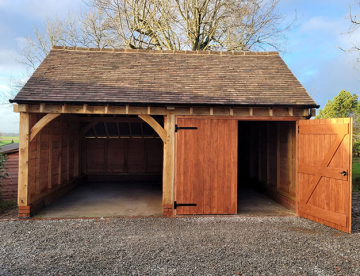
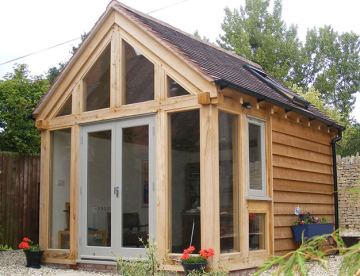
In a kitchen extension, those beams might sit above a large dining space. In an annexe, they can create a vaulted ceiling with a real sense of height. In a garden building, they can turn what could have been a simple outbuilding into a proper architectural feature.
This is why well-made oak framed buildings tend to have such a strong presence.
You don’t need to cover the frame with layers of decoration to make it interesting. The structure itself does the work.
The Problem With ‘One Size Fits All’
Mass-produced timber kits are, by definition, built around repeatability.
That’s useful if you’re producing hundreds of similar components. It becomes less useful when you’re working with an individual property that has its own proportions, surroundings and architectural character.
A period farmhouse might need an extension that responds to existing stonework. A large country estate may require an annexe with a particular orientation and roofline. A modern property might call for large areas of glazing and a much cleaner interpretation of oak framing.
A standard kit can’t necessarily account for all those variables.
A bespoke frame can.
The building is designed around the project rather than the project being squeezed around a predetermined product.
Traditional Methods, Modern Requirements
Choosing traditional craftsmanship doesn’t mean accepting an old-fashioned building.
This is an important distinction.
A traditionally crafted oak frame can sit at the heart of a thoroughly modern building. Contemporary insulation, high-performance glazing, underfloor heating, discreet lighting and modern kitchen and bathroom facilities can all be incorporated into the wider design.
From the outside, you might see a beautiful oak frame rooted in centuries-old building traditions. Inside, you can have all the comfort and performance you’d expect from a modern home.
That’s part of the appeal.
The traditional element isn’t there to make the building less practical. It’s there to give it character.
Why Experience Matters
Working with oak requires more than knowing how to assemble timber.
Experienced oak frame builders understand how individual pieces behave, how joints should be proportioned and how the frame will come together as a complete structure. They also understand the visual side of the craft – because an oak frame needs to work aesthetically as well as structurally.
Small details can make a surprisingly large difference.
The position of a joint. The shape of a brace. The way two beams meet. The choice of where to leave a natural curve in the timber. None of these decisions are particularly obvious when you’re looking at a finished building, but together they create the character that makes a hand-crafted frame feel different.
It’s the same principle you’ll find in any traditional craft. The quality is often in the details.
Built for More Than the Present
There’s also something reassuring about using a construction method with a long history.
Oak-framed buildings have been part of the British landscape for generations. Properly designed and maintained, oak has the potential to age beautifully rather than becoming increasingly tired-looking.
The timber changes. The colour develops. The building settles into its surroundings.
That can be particularly appealing when you’re adding something to a country estate or a period property. You aren’t trying to create something that looks fashionable for five years. You’re creating a structure that should still feel appropriate many years from now.
Paying for Craftsmanship
A hand-crafted oak frame will generally require a greater investment than a mass-produced timber kit. That’s not something to hide – it’s part of the proposition.
You’re paying for skilled labour, individual design, carefully selected timber and traditional joinery. You’re also paying for a building that isn’t simply pulled from a catalogue.
For homeowners investing significantly in their property, those differences can matter.
The finished building becomes more than additional floor space. It becomes part of the character of the estate – something that can be enjoyed now and appreciated long after the original construction has been completed.
A Different Way of Building
Ultimately, the difference between hand-crafted oak and mass-produced alternatives comes down to approach.
One is built around efficiency and repeatability. The other is built around the individual project.
Neither needs to be disguised as something it isn’t. But if you’re looking for a structure with genuine character, visible craftsmanship and a connection to traditional British building, there’s something special about seeing a frame assembled joint by joint.
Mortise and tenon joints. Wooden pegs. Individual pieces of oak. Skilled hands bringing them together.
These are old techniques, but they’re far from outdated.
If you’re considering a new oak-framed extension, annexe, outbuilding or country property project, explore the work of WM Oak Frame at WMOakFrame and discover what can be achieved when traditional craftsmanship is at the heart of the design.